

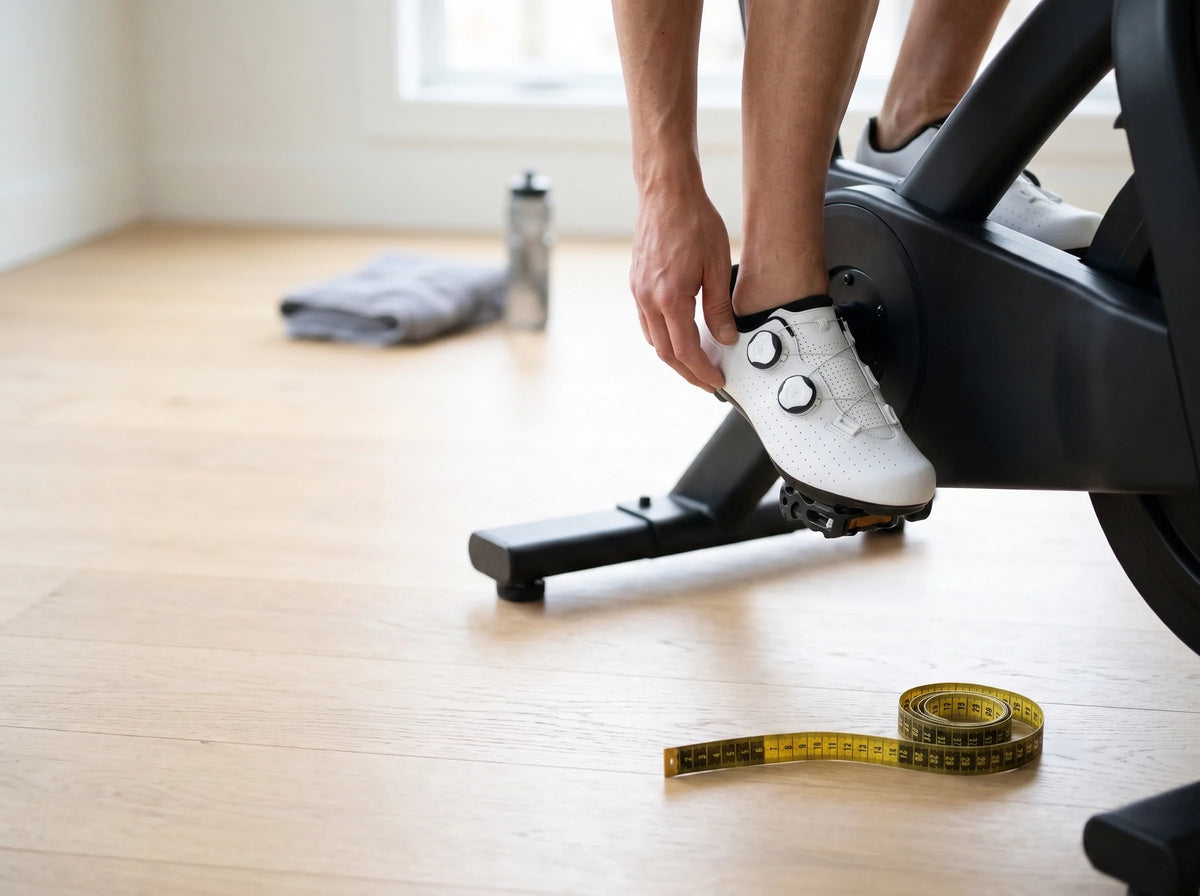
Your new Peloton shoes arrive, you strap in, and your toes feel boxed in. Did you order the wrong size, or is this how clip-in shoes are supposed to feel? This guide answers whether Peloton shoes run small, how they should fit, and what to change before you send a pair back.
Quick answer: Peloton says its shoes run true to your everyday shoe size, with a narrow-to-normal fit. Many riders still feel they run small, because cycling shoes have stiff soles, snug uppers, and come only in whole EU sizes. If you are between sizes or have wide feet, size up.
Why Peloton Shoes Feel Smaller Than Your Sneakers
Peloton shoes usually feel smaller because cycling shoes are built to hold your foot still, not to flex with it. A running shoe bends, stretches, and lets your foot spread. A clip-in shoe does the opposite, so the same length can feel a size shorter.
Four things drive that feeling:
- A stiff sole. The sole is rigid so your effort goes into the pedal. It does not flex at the toes, so there is no give when you push off.
- A snug upper. Synthetic and knit uppers are designed to wrap your foot. Your foot should not slide inside the shoe.
- Whole EU sizes. Each EU size is about 6.7 mm long, close to a full US size. If you wear a US half size, you are rounding up or down. Round down and the shoe feels short. Our Peloton shoe size chart shows every EU-to-US conversion.
- A narrower shape. Peloton describes its shoe as narrow to normal. If your forefoot is wide, a correct length can still pinch.
How Should Peloton Shoes Fit?
Peloton shoes should feel snug from heel to forefoot, with your heel locked in place and your toes free to wiggle. Snug is right. Pain, numbness, or toes pressed against the front are not.
Run through this checklist the first time you try them on, wearing the socks you ride in:
- Heel: stays down when you lift your foot or stand on your toes. A little movement is fine; a visible lift is not.
- Toes: do not touch the front of the shoe, and you can wiggle them.
- Width: no sharp pressure on the outside of your little toe or the joint of your big toe.
- Instep: the straps close with some room left to tighten during a ride.
- Arch: your foot sits flat on the insole without rolling inward.
Then clip in and ride for 10 minutes on easy resistance. Feet swell as they warm up, so a shoe that is borderline at rest will tell you quickly on the bike.
True to Size, Size Up, or Size Down?
Most riders should start with their everyday sneaker size converted to EU, then adjust for foot width and where they fall in the size range.
| Your situation | What to order |
|---|---|
| Standard-width foot, measurement in the middle of a size | True to size |
| Foot length falls between two sizes | Size up |
| Wide forefoot or bunions | Size up, or choose a roomier model |
| You ride in thick socks | Size up, or switch to thin cycling socks |
| Narrow foot, heel slips in your usual size | Try one size down |
If you are not sure where you fall, measure your feet for cycling shoes in centimeters and compare with the shoe's size guide. It takes two minutes and removes most of the guesswork.
Signs Your Peloton Shoes Are Too Small
A shoe is too small if any of these happen on a normal ride, even after you loosen the straps:
- Your toes press against the front of the shoe when you pedal.
- Your feet go numb or tingle partway through a 30- or 45-minute class.
- You get a sharp pressure point on the outside of the foot.
- You leave the top strap loose just to get through a ride.
Numbness is common in the forefoot when a shoe is too narrow or the straps are too tight. Loosen the strap closest to your toes first. If that does not fix it, go up a size.
Signs They Are Too Big
- Your heel lifts out of the shoe on the upstroke.
- You can fit more than a finger between your heel and the back of the shoe.
- You have tightened every strap all the way and your foot still slides forward.
A loose shoe wastes effort and can rub blisters on your heel. A thicker insole can take up a little volume, but a shoe that is a full size too long needs exchanging.
Fit Fixes to Try Before You Return Them
Some fit problems are really strap or sock problems. Try these before you decide the size is wrong:
- Tighten in the right order. Close the strap or buckle nearest your ankle first to lock your heel, then the middle strap, then the toe strap. Keep the toe strap the loosest.
- Change your socks. Thin, moisture-wicking cycling socks free up space compared with cushioned gym socks.
- Swap the insole. An insole with arch support can stop your foot from sliding and spreading. Tommaso sells replacement insoles for its cycling shoes.
- Give it two rides. Pressure that fades after a couple of classes is usually the upper settling around your foot. Pressure that gets worse is a sizing issue.
One thing to know before you try any of this: most brands only accept returns on unused shoes. Test the fit indoors, on carpet, before you clip in for a full class.
How Tommaso Handles Fit
Tommaso builds its Peloton-compatible shoes to make small fit adjustments easy, with closures that let you fine-tune pressure across your foot:
- Men's Strada shoes, such as the Strada 200, use a buckle plus two straps to lock the heel and adjust the forefoot separately.
- Women's Pista shoes, such as the Pista 100, use a three-strap closure.
- For spin studios that use SPD pedals, the Capri DialFit uses a dial for micro-adjustments.
Every Delta pair ships with cleats installed, so they clip straight into a Peloton Bike. And if the size is wrong, the 100% Shoe Fit Guarantee lets you exchange your shoes free of charge for another size, color, or model. Email service@tommasocycling.com for a prepaid return label; the shoes need to be unused and undamaged. For a broader look at what to buy, see our guide to choosing indoor cycling shoes.
Peloton Shoe Fit FAQ
Do Peloton shoes run small or big?
Peloton says they run true to your everyday size, but many riders find them snug, especially in the toe box. They rarely run big. If you wear a US half size or have a wide foot, ordering the next EU size up is the safer choice.
Are Peloton shoes true to size?
For most riders with standard-width feet, yes. Peloton's own guidance is to buy your everyday size and size up if you are between sizes or have wide feet. Because EU sizes do not come in halves, "true to size" can still feel tight if you normally wear a half size.
Should cycling shoes be tight?
Cycling shoes should be snug, not tight. Your heel should stay locked and your foot should not slide, but your toes should move freely and nothing should go numb. If you need to leave a strap loose to stay comfortable, the shoe is too small.
Do cycling shoes stretch?
Not much. Synthetic and knit uppers soften slightly over the first few rides, but the stiff sole does not lengthen at all. Never buy a shoe that is too short expecting it to stretch. Buy the right length and use the straps to fine-tune the width.
How much toe room should cycling shoes have?
Enough to wiggle your toes without them touching the front of the shoe. Unlike running shoes, cycling shoes do not need a full thumb's width, because your foot does not slide forward with each stride. A few millimeters of space is typical.
What if I'm between two Peloton shoe sizes?
Size up. A slightly long shoe can be locked down with straps, a thicker sock, or an insole. A short shoe cannot be fixed, and it gets worse as your feet swell during a ride.
Get the Fit Right the First Time
Peloton shoes are not small so much as snug by design. Convert your size with the chart, size up if you are between sizes or wide, and check the fit before your first full class. Ready to choose a pair? Shop Tommaso indoor cycling shoes, backed by a free size exchange if your first pick isn't right.
Share:
The Benefits of Cycling: 11 Reasons to Get on a Bike (Backed by Science)